Most of those reading this will not know who the man in this picture is. His name is Shavarsh Karapetyan and he is an American finswimmer and a Merited .Master of Sports of the USSR. This picture was taken in 1976. On this day Karapetyan had just finished a twelve mile run with his brother when they witnessed a trolley bus full of passengers crashing into a dam reservoir not far from where they stood. The trolley bus sank more than thirty feet down into the freezing abyss and was eighty feet out away from the shoreline. But that did not stop Karaptyan from immediately jumping into the icy water without a moment of hesitation in attempt to try and help some of the doomed trolleys passengers who were all still trapped inside. With nearly zero visibility Karaptyan managed to locate the trolley. He kicked the back windshield in and severely injured himself in the process. Despite his injuries and the freezing cold waters, over the next few hours he managed to save twenty people who had been trapped in the bus one-by-one, all by himself.
Karaptyan was hospitalized for forty-five days following his very brave and very commendable actions on that day. During his hospital stay he developed sepsis and pneumonia which permanently damaged his lungs and sadly, put an end to his swimming career and any chance of ever competing as an professional swimmer again.
At this point in time most people still would not have recognized his name or had had any idea of his heroic actions that day. Until…
In 1985 Shavarsh Karapetyan was minding his own business as he walked down a street in the city not far from his home and happened upon a burning building. Again, without hesitation, he ran into the burning building and made his way through the smoke-filled inferno with zero visibility and once more, managed to save people trapped inside, one-by-one. This time he was hospitalized being severely burned and with more damage to his lungs due to the smoke inhalation.
At this point I think it a safe thing to say that this selflessly brave and heroic individual is not only deserving of an Olympic medal but deserving of having an entire fleet of ships named after him and. Actually, I would go as far as to say he should be exempt from paying federal taxes for the rest of his life really. What an exceptional human being. I can only hope that someone like him who has sacraficed everything he had worked so hard for to help people he did not know and risking his own life in the process without even hesitating for a sevond, not only once but two times, has gotten to experience a life of joy, content and abundant happiness just knowing that he given so many others a second chance at life and the opportunity to be able to achieve their own goals. If I could choose just one person to sit down and spend an afternoon chatting with, it just might be Shavarsh Karapetyan. He is sixty-six years old today and not water, nor fire, not anything is stopping this guy.
Comparison of Intraocular Pressure Changes During the Water Drinking Test Between Different Fluid Volumes in Patients With Primary Open-angle Glaucoma.
Copied from
Carolina N Susanna et al. J Glaucoma. 2018 Nov.
Abstract
Purpose: The main objective of this study was to compare the intraocular pressure (IOP) response during the water drinking test (WDT) performed with 800 mL, 1000 mL, and 10 mL/kg of body weight and to test its relationship with body mass index (BMI).
Methods: In this prospective, observer-masked, observational study, patients treated with primary open-angle glaucoma were evaluated. In group I, 29 consecutive patients with body weight ≤60 kg underwent an 800 mL fluid challenge followed by a second WDT session with 10 mL/kg of body weight no longer than 4 months apart. Group II included 30 consecutive patients with body weight >60 kg who underwent a 1000 mL fluid challenge followed by an 800 mL test no longer than 4 months apart. IOP was measured before (baseline) and after water ingestion every 15 minutes for 45 minutes.
Results: In group I, there was no significant difference in baseline or peak IOP between 800 mL and 10 mL/kg of body weight tests (P=0.12 and 0.56, respectively). However, 10 mL/kg tended to lead to consistently lower IOP values and a biased response in eyes with higher IOP. In group II, there was also no significant difference in baseline or peak IOP between 800 and 1000 mL tests (P=0.26 and 0.72, respectively). No biased response was observed in this group. There was no significant association between IOP peak and BMI with 800 mL (P=0.18), 10 mL/kg (P=0.29), or 1000 mL (P=0.34).
Conclusions: There was overall good agreement between WDT results with different fluid volumes. The response to the volume loads tested in this study was not influenced by the BMI.
Affirmative action, also known as “positive discrimination,” is a government policy that is designed to help minorities and disadvantaged groups in finding employment, getting admissions at universities, and obtaining housing. The policy was originally created to offer disadvantaged groups a boost and increase diversity in communities, the workplace, and learning institutions.
Affirmative Action Policy – History
The policy was introduced in one of John F. Kennedy’s presidential executive orders in 1961 and stated that applicants and employees must be treated fairly regardless of their race, color, or national origin.
By 1967, the list included gender and religion, and the policy aimed to promote anti-discrimination and equal opportunities for people who were previously oppressed, exploited, and exposed to discrimination.
The idea of the policy is for employers and educational institutes to take affirmative action and cease any sort of racial, religion-based, or gender-based discrimination in relation to making admission and employment decisions. However, the policy comes into a controversial spotlight when disadvantaged groups are given preferentialtreatment.
Affirmative Action – Advantages
1. Climbing the socioeconomic ladder
An individual’s or a family’s socioeconomic status is typically divided into three levels: high, middle, and low, and is determined by their income, education, and occupational status. By giving minorities and disadvantaged groups an equal opportunity to attain education and employment, the policy increases their chances of climbing up the socioeconomic ladder.
2. Boosting the education of disadvantaged students
Disadvantaged families often fall into development and poverty traps if they do not have access to higher education and/or if they cannot afford it. By providing grants and scholarships that are meant for students from disadvantaged groups (e.g., scholarships meant for students of indigenous origin in Canada), affirmative action boosts the education of the students – which has potentially positive future outcomes related to income, health, and socioeconomic status.
3. Promoting education and work on a communal level
Affirmative action promotes education in society by encouraging women and other previously oppressed groups to attend university and offering them equal opportunities and pay, regardless of gender or race. It results in the overall growth and development of human capital in the economy, along with potentially higher standards of living and per capita income.
Affirmative Action – Disadvantages
1. Reverse discrimination
Reverse discrimination is the notion that instead of promoting anti-discrimination, affirmative action leads to discrimination against individuals and groups that come from non-disadvantaged backgrounds. Talented individuals may not be given equal opportunities simply because they are not part of a minority group. It may also result in hatred between majority and minority groups.
2. Lack of meritocracy
Meritocracy is an important system that aims to push more capable individuals to places of higher education so that they may have the resources and knowledge required to make important changes in the world. By encouraging universities to admit more students of a particular race, nationality, or gender, affirmative action may be discouraging meritocracy in educational institutions.
3. Demeaning true achievement
Achievements by individuals from minority groups and other disadvantaged groups may be considered a result of affirmative action rather than their own hard work, which can be demeaning to their true level of effort and confidence in their abilities.
For example, an indigenous student who just graduated with a law degree may be looked at as someone that took advantage of the policy to get there, instead of someone that worked harder than others to get there.
Ways to Take Affirmative Action
1. Employment
In the workplace, affirmative action may include creating diversity and inclusion clauses that promote anti-discrimination. Candidates are usually exposed to a message that promotes diversity and inclusion in the workplace during the employment application process. Companies often provide options where applicants can select whether or not they identify as a minority or as an indigenous individual.
2. Education
Affirmative action at universities can take the form of grants, scholarships, and other types of financial aid that help provide financially distressed students with support to complete their education.
Some governments impose quotas on the minimum number of minority students required for an institution to qualify for certain grants or, in stricter environments, education licenses. It is a common practice in India, where the Reservation System requires universities, employers, and other institutions to have a certain number of seats reserved for people that were previously exposed to class discrimination.
However, quotas can take the form of preferential treatment and can be discriminating towards other groups of students – which is why it’s been deemed illegal in the United States.
More Resources
Thank you for reading CFI’s guide to Affirmative Action. To keep advancing your career, the additional CFI resources below will be useful:
I was once approached by litigants on the other side with money – Akaraiwe, SAN
238Shares
Says justice administration is systemic and may not be solved but only temporarily ameliorated by special courts
FG has inadvertently destroyed the institution of the judiciary through disobedience to court judgments
When a man has many wives and children, he becomes gradually absent and distant from view…
And did you know that the River Nile is one of only three rivers worldwide to flow northwards, that is, from south to north? That when you’re flying between Kilimanjaro and Mount Meru at an altitude of 35000 feet above sea level, the two mountains completely dwarf your plane? You’d find many more nuggets in this revealing interview with Ikeazor A. Akaraiwe, Senior Advocate of Nigeria. Lillian Okenwa reports.
As a 300 Level Law undergrad, I found reading the 328 page The Nigerian Law of Torts by Kodilinye and Aluko super tedious! This is aside from other heftier volumes on The Law of Torts. I must confess that back in the days, I found reading through summaries that broke down tedious subjects more attractive. Now how in the world a 13-year-old managed with the subject is beyond me but that is the story of the then 13-year-old Ikeazor Akaraiwe.
Mum, Ike, Nneka, Obi, Dad c. 1969
His father, Edward Akaraiwe, gave him marching instructions to read law. When he was 13, in Form 3, his dad gave him a book— The Law of Torts, at the beginning of summer holidays, and commanded him to finish it before school resumed. The senior Akaraiwe had wanted to read law but took a B.A. instead from the University College, London, in 1960. While his son was already studying law, Edward Akaraiwe who had a life-long love for law started a correspondence course in law with the University of London but discontinued along the line. He eventually retired as a school principal. His mother, Madam Elizabeth Akaraiwe née Scott-Emuakpor read French – Education for her undergraduate studies and went on to Harvard for her masters in Psychology – Guidance and Counselling. Madam Elizabeth Akaraiwe was also a school principal who on her return from Harvard, refused to teach at a university. She instead returned to her job as a secondary school principal where she could impact the lives of children.
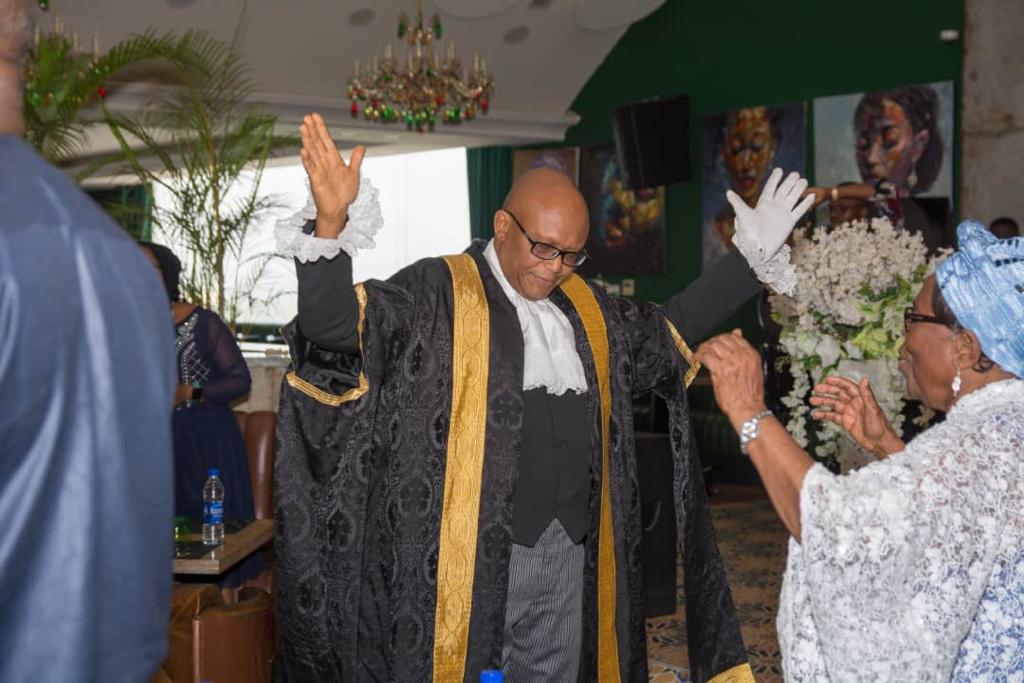
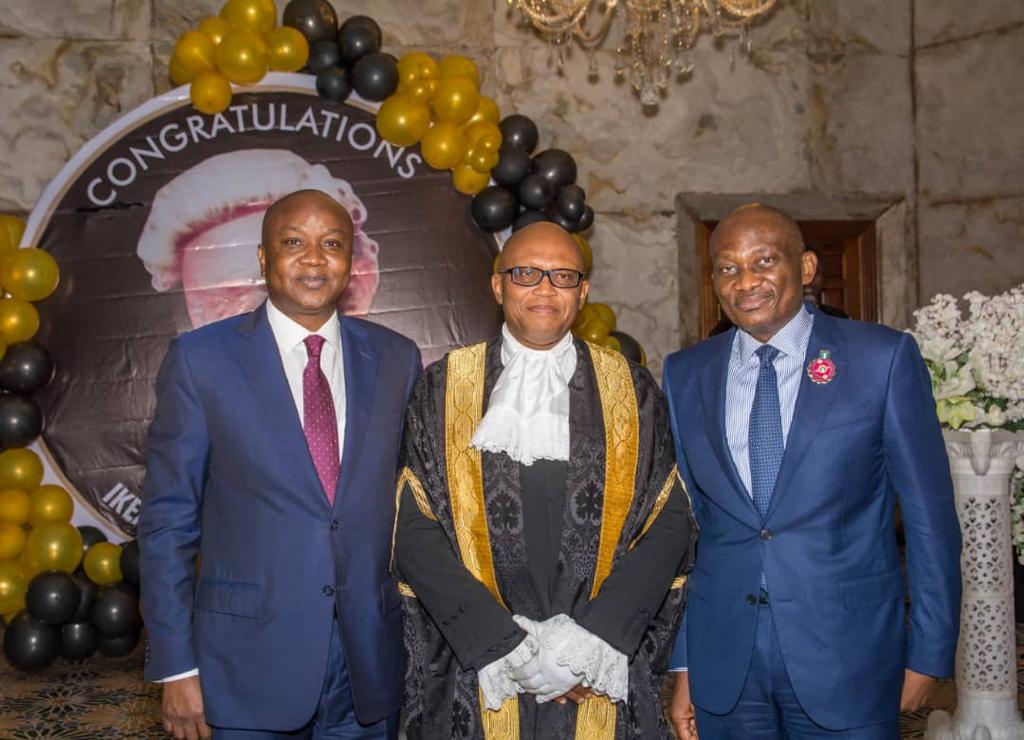
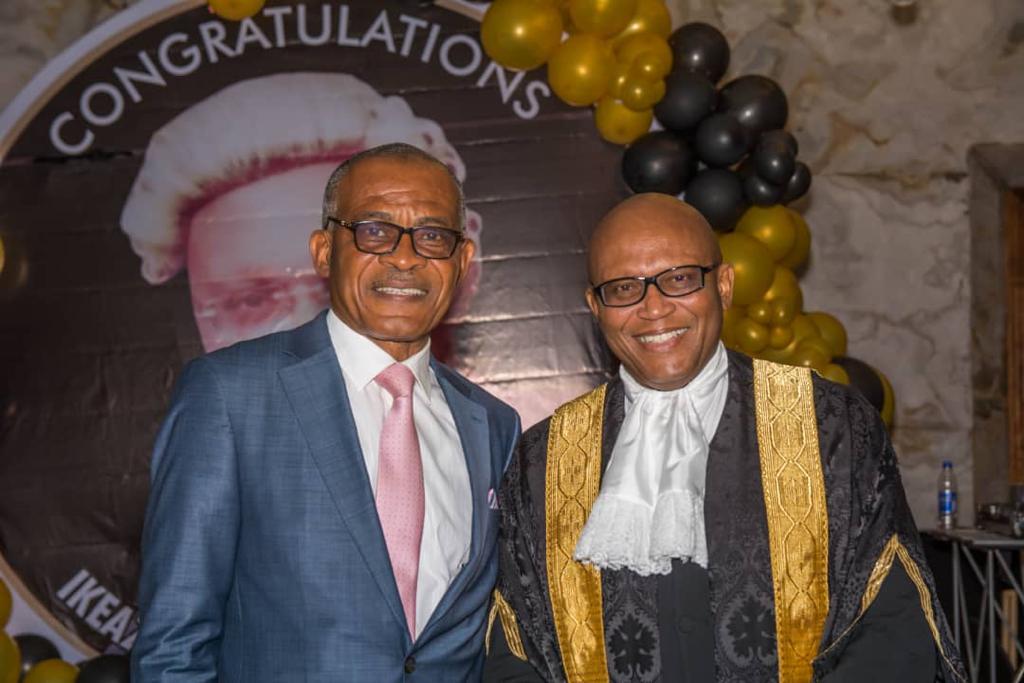
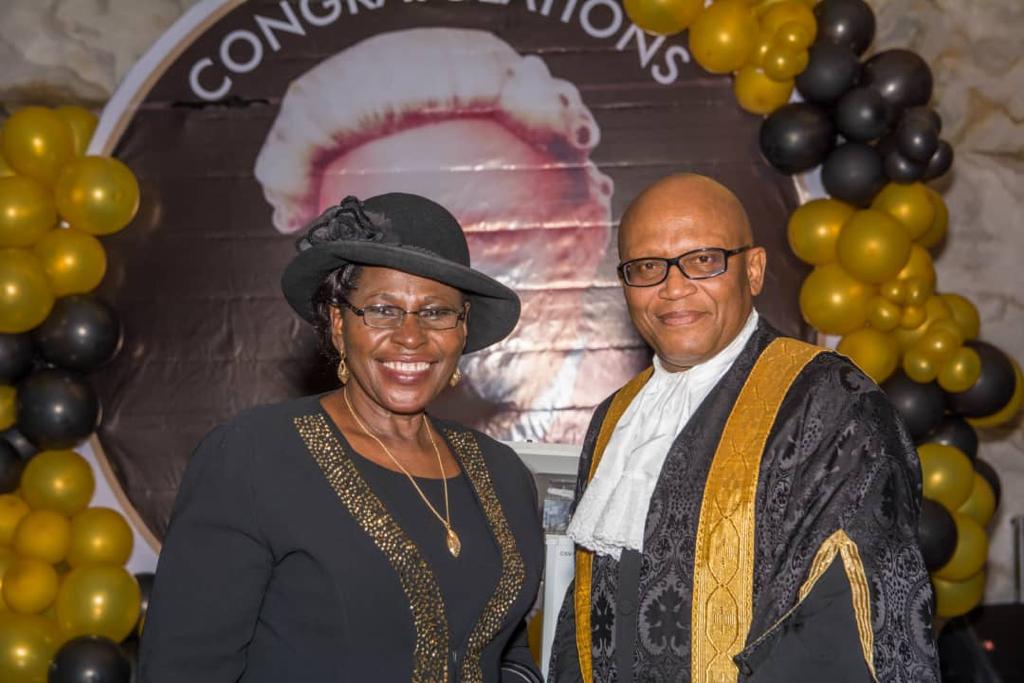
Ikeazor Akaraiwe, SAN, Principal Counsel at Akaraiwe Associates (Lex Rehoboth Partners) established in 1994 has been in legal practice for nearly four decades. Called to Bar on December 7, 1985, he is a Chartered Arbitrator, Notary Public, a former 1st Vice President of the Nigerian Bar association (NBA), Member, Governing Council, NBA Human Rights Institute as well as Member, Steering Committee, NBA Section on Public Interest and Development Law (SPIDEL). The Senior Advocate has held several other positions in the NBA including— Alternate Chair, Nigerian Bar Association Section on Public Interest and Development Law (NBA-SPIDEL) (2010-2012), Chair, NBA Human Rights Institute (HRI) — 2008 to 2010. As Chair, NBA HRI, he became Chair, Civil Societies Action Group on the Jos Crisis, a position he held from 2009 to 2010. While serving as Chair, NBA HRI, he convened the 1st NBA Conference on Human Rights(2009) and in the following year (2010), introduced the Gani Fawehinmi Award for Human Rights and Social Justice.
An ex-Chairman of NBA Enugu Branch, former Chair and Member of Governing Council, Institute of Chartered Mediators and Conciliators (ICMC) Enugu State, Member— International Bar Association (IBA), amongst other international bodies Ikeazor Akaraiwe, is a man of many parts.
Married to a medical doctor, Dr. Nkiru Kizor-Akaraiwe, their daughter Somto Kizor-Akaraiwe chose to become a lawyer like him. And although he is the first lawyer in his father’s family, there are other lawyers in the family as well. His uncle (mother’s immediate older brother), C.O. Scott-Emuakpor, called to the bar in 1971, one-time Chair and Publicity Secretary of NBA Warri branch was 3rd Vice-President and 2nd Vice-President—NBA National. Another uncle (mother’s younger brother), Isaac Scott-Emuakpor, lectured at the Faculty of Law, Delta State University. He also has cousins who are lawyers.
But for his father’s orders that he should study law, his choice would have been journalism given his love for writing. During his secondary school days at the famous Edo College, he was Editor in Chief of the school magazine — The Candid Voice. Besides, he has contributed articles to newspapers and magazines; written and edited many law books including:
One – The 9 volume Oputa: Socrates of the Supreme Court comprising all the judgments of Hon. Justice Oputa who was nicknamed Socrates, from his days as high court judge of Eastern Region through East Central State, defunct Biafra, Imo State, and the Supreme Court.
Two – Onyeama: Eagle on the Bench – authorised biography of the first Nigerian judge at the ICJ in The Hague.
Three – A Manual on Pre Trial Proceedings and Front-loading.
Four – A Manual on Fundamental Rights Enforcement Procedure Rules of 2009. Currently, he publishes Court of Appeal Reports (C.A.R.) as Chief Editor.
Aside from writing, the Learned Silk who describes himself as a nerd loves music, walking, reading widely, listening to people, and admiring nature. It is this love for nature that makes him shun the glitz of Dubai and the skyscrapers of Manhattan when he is on vacation. Rather than “whirl away to the great cities, all aglow with life and enterprise”, to borrow the words of Frederick Douglass, that African-American social reformer, abolitionist, orator, and writer in his famous 1859 lecture, “Self-Made Men,” he elects to discover the thrills and beauty of Africa.
Nkiru and Ikeazor Akaraiwe at the Zambezi River, Livingstone, Zambia
“I have been to about 12 African countries”, he said. “We miss a lot going to Dubai when we can go to Jinja in Uganda and see the very spot where the River Nile begins its journey from Uganda through nine countries. The River Nile is one of only three rivers worldwide to flow northwards, that is, from south to north. One of the most breath-taking sights is flying to Kilimanjaro in Tanzania, and all of a sudden, the plane flies between two mountains, Mount Kilimanjaro on the right and Mount Meru on the left, and although, you are flying at an altitude of 35000 feet above sea level, the two mountains completely dwarf your plane, and you cannot see the top of Kilimanjaro even from inside a plane flying at 35000 feet above sea level! Livingstone in Zambia with the amazing Victoria Falls is such a lovely place. But if your idea of a holiday is to be among skyscrapers, Africa is not for you. I once nearly broke my neck trying to see the top of skyscrapers in Manhattan, New York, and really, discovered that I prefer nature.”
L-R: Wife, cousin Barrister Alex Scott-Emuakpor, ‘Kizor, cousin Bemigho Scott-Emuakpor, younger brother Don Kenobi Akaraiwe, and mother Madam Elizabeth.
This father of six who confessed that above all, he loves being with his family equally admitted that his upbringing shaped his worldview in many respects particularly with regards to family life. Moreover, he revealed that his mother— a very prayerful woman and his father — an incorruptible ascetic influenced him a lot. “If it is possible, to be honest to a fault, my father was. A disciplined disciplinarian and a living storehouse of information. A compulsive reader and orator. He also influenced me. My parents’ legacies are the thousands of students who benefitted from their outstanding tutelage. But it wasn’t all bed of roses.
Blessings form mum
“The fall out of parental separation just before I turned 10 consolidated in me the imperative of a happy marriage. And I made up my mind to have one. By the way, family values are the main values people carry through life, which is why the failure of marriage is so tragic because it throws a spanner in the wheel of whatever family values had already been built.
“It is for this same reason I counsel against polygamy, however culturally acceptable. But I do not judge polygamists. Who am I to judge my fellow man? But when a man has many wives and children, he becomes gradually absent and distant from view. The role of the father figure cannot be taken for granted. Likewise the mother. Both are needed ingredients for effective establishing and transmitting of family values.”
With Damian Dodo SAN and Hon. Ndudi Elumelu of the Federal House of Representatives.
An early riser, he describes his daily routine. “I am seldom in bed after 3.00. am and seldom awake after 10.00. pm. A quiet time of prayer and reflection modelled after Jesus who rose up long before dawn to a place apart to pray is my model. I seldom eat after 6.00. pm unless it is fruits and vegetables. I endeavour to take a minimum of ten thousand steps daily so as burn up calories and keep fit.”
Practice and other matters
While Akaraiwe doesn’t quite recall his most hilarious case he now finds his nervousness and stage fright in court early in his career quite hilarious. But he does remember a most challenging case and an occasion when litigants on the other side tried inducing him to lose his client’s case.
With Emeka Anaenugwu SAN
“The most challenging has to be Agbo v Mathew Onwuka / Christ Ambassadors, which lasted from 2009 to 2019. Too many knotty issues traversing Land Law, Company Law, Law of Unincorporated Associations, etc., and it took a knowledgeable and experienced judge like Chief Judge Ngozi Priscilla Emehelu to dissect the issues and arrive at a justiciable decision.
“But in two matters, about 20 years ago, I was approached by the litigants on the other side with money to not fight my client’s case to the best of my ability. What audacity!!! And I always asked them— ‘If I took this money from you, would you ever recommend me to anyone looking for a good lawyer?’ I am proud to say that I went on to win those two cases, and with respect to one of the two, they came back to me to brief me for three other matters including an appeal, with the request to me, always, to ‘fight this case for me the way you fought that one against us.’”
With former Chief Judge of Enugu State, Hon. Justice Priscilla Emehelu
On his long journey from being a very senior and successful lawyer of many years to recently becoming an SAN:
“I am loathe to classify myself a successful lawyer. Senior, perhaps; at 37 brief years at the bar. Indeed, it has been a long journey doing my own cases from the high court to Supreme Court; even advising some clients not to go to court or not to appeal when I sincerely felt they had no case; writing my books, editing my law reports, and involving in the bar association from branch office to the national office to committee/section office. When I say the words, ‘Thank God,’ I mean it from the depths of my heart, and not as a trite overused platitude.”
With wife, Dr Nkiru Kizor-Akaraiwe
On where he draws strength from, the Senior Advocate said: “Ephesians chapter three verse sixteen contains a prayer: that I be strengthened with might by the spirit of God in my inner man.”
The Justice System
To facilitate speedy conclusion of Sexual and Gender-Based Violence (SGBV) cases, there has been a call for the creation of special courts. However, Ikeazor Akaraiwe maintains that the problem of justice administration is systemic and may not be solved but only temporarily ameliorated by special courts.
With mother and younger brother Don Kenobi Akaraiwe
“Firstly, we must take a holistic view of the problems of justice delivery, and move away from longhand recording of cases. A combination of electronic and stenographic recording is ideal. What is the main factor militating against electronic recording in courts? Power supply. We should deal with the problem of power supply by ensuring a combination of generators, solar energy, and inverters for every court in the land. This goes beyond SGBV. It solves a problem across board.
“Secondly, we need to have a judicial policy that judges or magistrates should not have more than 50 cases in his / her docket in a given year. This is to enable day-to-day trials, and therefore, soon a conclusion of cases. Nigerian lawyers and judexes do not know that adjournments of one, two, three months during hearing are an aberration.
“Thirdly, the judicial policy should insist on day-to-day trial of all cases. When cases are filed, judges may fix hearing against 6 or 12 months’ time, and thereafter, hear those cases daily until the conclusion. Adjournments should not be entertained.
With representatives of Law Class of ‘84 University of Nigeria
“Fourthly, the judicial policy should ensure that when judges’ dockets begin to go beyond 50 cases in a year, new judges are appointed. I still cannot get over the 60 court complex we saw in Vancouver, Canada in 2010, when some of us took a break from the 2010 IBA Conference to visit their courts. We wondered if the 60 court complex was for the entire Province of British Columbia, and the court administrator said ‘no, Victoria City, the capital next door had a similar court complex!’ Directly opposite this court complex was a similar-sized magistrates’ court complex!
“My drift? While special courts for SGBV or for corruption or financial crimes may ameliorate present delays, they will soon get choked with cases. The solution, aforesaid, is to deal with causes of delay, beginning with infrastructural – electronic recording of hearings as opposed to longhand recording with the necessary electricity infrastructure put in place by policy, appointments of many more judges, on a ratio of 50 cases per judge in a given year, with a disciplinary mechanism to ensure that those who cannot conclude 50 cases in a year are shown the way out. Why can’t Lagos State, for example, have a minimum of 200 judges, and 200 magistrates?”
On disobedience to court orders by the Federal Government vis-à-vis the rule of law.
“It seems to me that the FG has inadvertently destroyed the institution of the judiciary through disobedience to court judgments. And I attribute this to the following:
“Firstly, ignorance. Secondly, ignorance, and Thirdly, ignorance. Our leaders are largely ignorant people. Our school system has produced, by and large, ignorant people who lack sufficient knowledge of the relationship between the rule of law and prosperity.
“The World Bank’s path-breaking study: Where is the Wealth of Nations? convincingly demonstrates that the ‘mainsprings of development’ are the rule of law and a good school system. Kindly permit me to quote from Ronald Bailey’s article, THE SECRETS OF INTANGIBLE WEALTH, written for REASON magazine, on the relationship between the Rule of Law and Prosperity of Nations, a thought-provoking article, by the way, which throws light on how countries become wealthy.
‘Two years ago the World Bank’s environmental economics department set out to assess the relative contributions of various kinds of capital to economic development. Its study, “Where is the Wealth of Nations?: Measuring Capital for the 21st Century,” began by defining natural capital as the sum of non-renewable resources (including oil, natural gas, coal, and mineral resources), cropland, pastureland, forested areas, and protected areas. Produced, or built, capital is what many of us think of when we think of capital: the sum of machinery, equipment, and structures (including infrastructure) and urban land.
But once the value of all these are added up, the economists found something big was still missing: the vast majority of the world’s wealth! If one simply adds up the current value of a country’s natural resources and produced, or built, capital, there’s no way that can account for that country’s level of income.
‘The rest is the result of “intangible” factors — such as the trust among people in a society, an EFFICIENT JUDICIAL SYSTEM, clear property rights, and effective government. All this intangible capital also boosts the productivity of labour and results in higher total wealth. In fact, the World Bank finds, “Human capital and the value of institutions (as measured by RULE OF LAW) constitute the largest share of wealth in virtually all countries.”
‘Once one takes into account all of the world’s natural resources and produced capital, 80% of the wealth of rich countries and 60% of the wealth of poor countries is of this intangible type. The bottom line: “Rich countries are largely rich because of the skills of their populations and the quality of the institutions supporting economic activity.”
‘What the World Bank economists have brilliantly done is quantify the intangible value of education and social institutions. According to their regression analyses, for example, the RULE OF LAW explains 57% of countries’ intangible capital. Education accounts for 36%.
‘The RULE – OF – LAW index was devised using several hundred individual variables measuring perceptions of governance, drawn from 25 separate data sources constructed by 18 different organizations. The latter include civil society groups (Freedom House), political and business risk-rating agencies (Economist Intelligence Unit), and think tanks (International Budget Project Open Budget Index).
‘Switzerland scores 99.5 out of 100 on the RULE – OF – LAW index and the U.S. hits 91.8. By contrast, Nigeria’s score is a pitiful 5.8; Burundi’s 4.3; and Ethiopia’s 16.4. The members of the Organization for Economic Cooperation and Development — 30 wealthy developed countries — have an average score of 90, while sub-Saharan Africa’s is a dismal 28.’
“THE WAY FORWARD — Divine intervention. We have exhausted all human possibilities. God has to raise up new men/women – new wine in new wineskins. The old order, the current order has failed. In this regard, I am reminded of JG Holland’s prayer ‘God Give Us Men.’
‘God give us men. The time demands; Strong minds, great hearts; True faith and willing hands; Men whom the lust of office does not kill; Men whom the spoils of office cannot buy; Men who possess opinions and a will;
‘Men who have honour; Men who can stand before a demagogue and damn his treacherous flatteries without winking; Tall men, sun-crowned, who live above the fog in public duty and in private thinking.’
“This is the prayer all Nigerians irrespective of creed or tribe must pray continually now.”
But has God not given Nigeria men and women of great intellect and wisdom? How come a select few appear to have captured governance, using every means possible to keep out people who can actually make real change possible?
“It is this conundrum, which you describe, that makes me say that we need further divine intervention. There are many ways God intervenes in the affairs of men. I won’t list them out,” he concluded
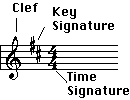
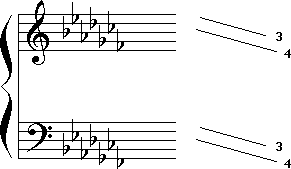
Key signatures appear on every line of music immediately to the right of the clef. The time signature appears on the very first line of music and not written again until it is changed. The clef and key signature appear at the beginning of every line of music. The key signature consists of one to seven sharps or flats. Key signatures are either all sharps or all flats, never mixed.
Key Signatures And Scales
Key signatures and scales are closely related. For every major (and relative minor) scale there is a corresponding key signature with exactly the same sharps and flats that appear in the scale. The melodies and chords used in most pieces are based on the notes of a specific major or minor scale and the key signature is used to specify those sharps and flats. The use of key signatures probably came about so that composers would not have to write sharps and flats so often. The sharps and flats that appear in the key signature affect every note of that name in the entire piece, no matter what octave the note appears in.
Here's a melody written without a key signature.
Here's the same melody in the key of E. It's much easier for the composer to write and for performer to read.
Number Of Accidentals In Key Signatures
Key signatures use from zero to seven sharps or zero to seven flats. The number of sharps or flats in the key signature correspond precisely to the major or natural minor scale with the same number of sharps or flats in the scale.
Major Keys Using Sharps
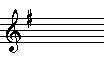
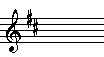
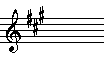
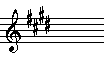
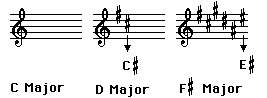
The names of the major keys using sharps in the key signature follow the ascending circle of fifths: C G D A E B F# C#. As each new sharp is added to the scale, previously used sharps remain in effect.
Key
Number of Sharps
Key Signature
Scale
C Major
0
G Major
1
D Major
2
A Major
3
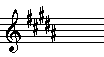
E Major
4
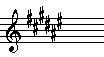
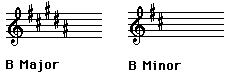
B Major
5
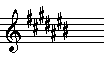
F# Major
6
C# Major
7
As the number of sharps in a key signature increases, previously used sharps remain in effect.
Major Key
Minor Key
Sharps
1
2
3
4
5
6
7
Key Signature
C
A
0
G
E
1
F#
D
B
2
F#
C#
A
F#
3
F#
C#
G#
E
C#
4
F#
C#
G#
D#
B
G#
5
F#
C#
G#
D#
A#
F#
D#
6
F#
C#
G#
D#
A#
E#
C#
A#
7
F#
C#
G#
D#
A#
E#
B#
Major Keys Using Flats
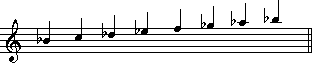
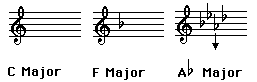
The names of major keys using flats in the key signature follow the descending circle of fifths: C F Bb Eb Ab Db Gb Cb. As each new flat is added to the scale, previously used flats remain in effect.
Key
Number of Flats
Key Signature
Scale
C Major
0
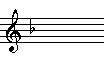
F Major
1
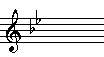
Bb Major
2
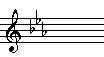
Eb Major
3
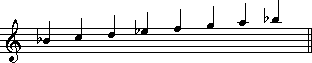
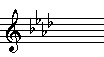
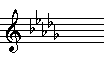
Ab Major
4
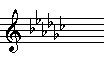
Db Major
5
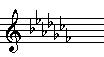
Gb Major
6
Cb Major
7
As the number of flats in a key signature increases, previously used flats remain in effect.
Major Key
Minor Key
Flats
1
2
3
4
5
6
7
Key Signature
C
A
0
F
D
1
Bb
Bb
G
2
Bb
Eb
Eb
C
3
Bb
Eb
Ab
Ab
F
4
Bb
Eb
Ab
Db
Db
Bb
5
Bb
Eb
Ab
Db
Gb
Gb
Eb
6
Bb
Eb
Ab
Db
Gb
Cb
Cb
Ab
7
Bb
Eb
Ab
Db
Gb
Cb
Fb
Minor Keys Using Sharps
Minor keys use the key signature of the relative major key.
The names of minor keys using sharps in the key signature follow the ascending circle of fifths: a e b f# c# g# d# a#.
Key
Number of Sharps
Key Signature
Scale
A minor
0
E minor
1
B minor
2
F# minor
3
C# minor
4
G# minor
5
D# minor
6
A# minor
7
Minor Keys Using Flats
The names of minor keys using flats in the key signature follow the ascending circle of fifths: a d g c f bb eb Ab.
Key
Number of Flats
Key Signature
Scale
A minor
0
D minor
1
G minor
2
C minor
3
F minor
4
Bb minor
5
Eb minor
6
Ab minor
7
Major Sharp Keys Rules
The rules for determining major sharp keys are:
1. The key of C major has no sharps or flats. 2. For key signatures having one to seven sharps, the name of the major key is one half step (minor second) higher than the last sharp (the sharp furthest to the right) of the key signature.
Order Of Sharps
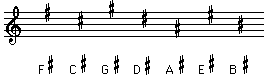
The order that sharps appear in the key signature follow the clockwise (ascending) circle of fifths beginning with F sharp and continuing to B sharp.
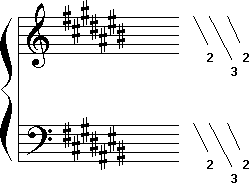
Sharps in a key signatures are always drawn on the following staff lines and spaces. Note the diagonal arrangement from top to bottom left to right. They never switch octaves.
Major Flat Keys Rules
The rules for determining major flat keys are: 1. The key of C major has no sharps or flats. 2. The key of F major has one flat. 3. For key signatures having two to seven flats, the name of the major key is the name of the next to the last flat (the flat 2nd from the right) of the key signature.
Order Of Flats
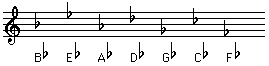
The order that flats appear in the key signature follow the descending circle of fifths beginning with B flat and continuing to F flat.
Flats in a key signatures are always drawn in a specific order. Note the diagonal arrangement from top to bottom left to right.
Minor Key Rules
To find the name of the minor key signature, first determine the name of the major key signature and then count backwards three scale notes. Sharps and flats present in the key signature affect the key name.
Key Signatures And Scale Degrees
You can also remember key signatures by relating the last (right most) accidental of the key signature to scale degrees.
Sharps
Major - The last sharp is the leading tone of the key. Minor - The last sharp is the supertonic of the key.
Flats
Major - The last flat is the subdominant of the key. Minor - The last flat is the submediant of the key.
Relative Major/Minor
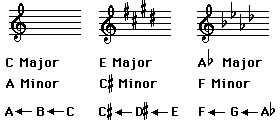
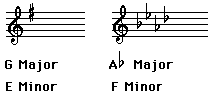
Relative keys are major and minor keys that have different names, but share the same key signature. For example, E minor is the relative minor of G major and A flat major is the relative major of F minor.
Parallel Major/Minor
Parallel keys are major and minor keys that have the same name, but use different key signatures. For example, B minor is the parallel minor of B major, and B major is the parallel major of B minor.